Friday, August 13, 2010

Thank you Nature.

Hi all:
I hope everyone has had a great week. It's been hot in the gardens and we could use some more rain but the thunder storms this week did dump some on us so that's good. I want to follow up my rant about corn last week by thanking the folks who offered feedback. I also wanted to let everyone know what my daughter Lizzie thinks. See below...
I think her vote is quite clearly defined.
Also, at the top of the blog is a photo of some of our garlic. You'll find a bulb in your share this week (two bulbs if you have a full share). This is the first of our garlic harvest (which is now all out of the field and curing in our greenhouse under a shade cloth). This variety is "Chet's Italian Red" and I'd like to know what everyone thinks of it, especially any garlic aficionados out there. I hope you all enjoy it. If you're looking for something to do with it, you could use some of it with the basil in this week's share to make pesto! Finally, everything is in sink to offer you pesto with both the basil and the garlic produced right here!
Pole beans are here! For those who don't know, pole beans are a long season crop in that they take a long time to come in and then - if everything goes well - they keep producing for a long time. We have several varieties in the garden and the first ones have come in. Pole beans are (in my opinion and that of many gardeners around the world) far superior to bush beans. They offer more diversity of appearance and the flavors are out of this world. Below is just one example. "Gold of Bacau" is the yellow bean in my hand. You can see how large it is and it's still tender and delicious. A bush bean that had beans inside the pod this size would be nearly inedible. This particular bean weighed 1 oz. Hey, I was curious. In the background are "Royal Burgandy Bush Beans". Don't let me give you the impression that bush beans aren't great...they have their role to fill in the garden of the sustainable Maraichere (Market Gardener). These Royal Burgandy beans are actually something I purchased as a trial this year, never intending to put them in the shares (I do this every year with several things and only grow them the next year if I like them). But they are yielding quite well and I really like them. They are excellent raw as a snack or appetizer. The beautiful color will fade when they are cooked.

The other beans in your share are these beautiful, striped pole beans. They are quite tasty and very interesting. They also produce a beautiful dry bean later in the season (if I can let any of them stay on the vine that long...they are so good).

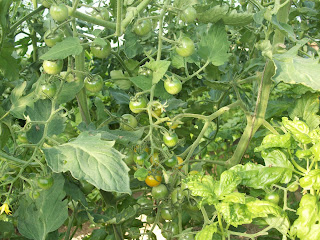
Finally, this week's share is one that involves a lot of tomatoes. I am thanking Nature for thus far sparing us from the blight. I haven't been able to get my greenhouse up and covered as fast as I had wanted but with help from Jim, John and Brittany, we're making progress and that's something. With Nature's help we still have tomatoes and they are coming in like crazy. You'll find several varieties in your share this week. I want to take a few moments to explain some things about dealing with heirloom tomatoes. I am interested in growing mostly heirloom tomatoes as opposed to hybrids. Heirloom varieties (for all veggies not just tomatoes) are those that have been passed down through generations from one grower to another. They come true to form and thus allow farmers to save seed. Hybrids do not do this. Also, heirlooms taste far superior to any hybrid (with the exception of Sungold Cherry Tomato...which several people are trying to de-hybridize). The reason that most of these varieties aren't grown in the global, industrial food system, is that they don't survive travel and don't 'look good'. I actually disagree with this as I find them terribly fascinating and love the look of nearly all heirloom tomatoes. I prefer variety and interest to carbon copied clones devoid of flavor and nutrients. But, they do have cosmetic 'flaws' and thus make them hard to market through visual means (i.e. t.v. ads and supermarket shelves). Heirloom tomatoes are how I know small farmers will survive. You simply can't produce this variety and flavor with hybrids that are designed to be picked before ripeness and shipped around the world in boxes stacked as high as a tractor trailer truck.
My basic rule about tomatoes is this: "Before you mention the way it looks, taste it...then we'll talk". This is what tomatoes are supposed to taste like. I actually remember the day I ate my last industrial tomato. I was at the diner up the road from my house and I ordered a salad. It came to the table, the iceberg lettuce was limp and pale and the tomatoes (I have a hard time even calling them that)...were beyond description. I took one bite, put down my fork and slid the salad back to the edge of the table. That was about 3 years ago. Now, I only eat tomatoes that are fresh from the garden (mine or another local farmer's) or were processed in my home by Emily and/or I for the purpose of canning, saucing or freezing. Bite into some of our tomatoes and I think you'll see why. Once you've had an actual tomato, you'll have an hard time going back. It's worth waiting 9 months a year for the real thing...kind of like asparagus except there you wait 11 and a half months.
That all being said, there are some things you should know about heirlooms to enjoy them fully. They have, as I said, cosmetic flaws. The two pictured above are displaying what's called, 'cat-facing' (one in a spiral, the other in a web). It's very common in larger tomatoes like the yellow/orange ones in your share. It's perfectly fine, it just means the tomato was growing fast and healing itself as it stretched. Just cut that part off and eat the rest. I usually slice them from the bottom and just leave the top green part for the pigs, chickens or compost pile.
Below are some other examples of things you might see. On the left is a paste tomato with split shoulders. Again, just cut around it and eat the rest. In the middle is a 'Goldie' tomato that shows signs of vine stress (meaning it probably was growing with the left side against the vine or trellis rope and grew abnormally) and cracking. This cracking (on the bottom) is also very common in heirlooms and is particularly a bane in Brandywine varieties. Same solution...cut around it. It's easiest to slice the tomato first and then cut the parts out that you don't want. Finally, in the lower right hand corner on this other Goldie with green shoulders is a small wound in the skin. It has scarred over. Most of them do this. If you get one like that, you can probably guess what to do. Cut around the scared part and eat the rest. The one in the photo isn't quite fully ripe with the green shoulders but when it has a spot like that I pick it anyway so it won't continue to grow, thus reopening the wound.
Finally, as I mentioned, these are delicate, extremely so, tomatoes. They wouldn't survive the industrial food system. In fact, some of the ones we harvested this week were damaged in their crates on the way from the garden to the milk house. This brings me to my final point. If you get one with a fresh crack or bruise on it, you need to eat that one right away. Perhaps check your tomatoes over when you get them home and look for damage. It could even happen in the bags and coolers. Any that are freshly wounded (you'll be able to tell) should be eaten that day or at the very latest the next day after being in the refrigerator. All others can sit on your window sill and be absolutely fine for a few days. Any longer and they should all go into the fridge. I hope you all enjoy and please keep the feedback coming. I appreciate hearing from everyone that has contributed to the Parker Produce CSA through feedback. It's valuable, important and great! Happy eating!


Well, I hope everyone has had a great week.


Friday, August 6, 2010

And so it begins!

Talking to many farmers and gardeners amongst my friends there is a common refrain. We all agree that its nice to go out in the garden and remember why we do what we do. After last summer, this year's weather is a wonderful change. When I walk through the garden I see things growing the way they were meant to...and it's great. You'll notice a huge increase in the amount of tomatoes in your share this week. I have great fun harvesting them, bagging them for all of you and eating the ones I bring home for our family. Again, especially after last summer.
To save on plastic we bag the tomatoes all together. If anyone has any questions about what type of tomato is in the bag, please let me know. But to get into some other information pertinent to tomatoes I have posted a photo below of several stages of tomato ripeness. The front-right row is a row of tomatoes that are not yet ripe. Behind them is the same row of tomato varieties that are actually ripe. You can tell because they are lighter in color when they aren't yet ripe. Also, sometimes they have what are called 'green shoulders'. A great example of this is the fourth tomato up which is an Orange Banana Paste Tomato. You can see there is green around the top.
Tomatoes can be ripened in two very easy ways depending on your goal. When you have some that are almost ripe, you can place them on the window sill in the sun and they will ripen in a couple of days. If you ever get one from us that is mostly green (which may happen as we approach frost) you can put them into a brown paper bag in a dark drawer. They ripen in the dark. You just need to check them frequently to ensure they don't over-ripen.
Also this week is the first installment of sweet corn. For those that have heard me talk about corn before, you may want to fast-forward through this part. I'm about to go off on a bitter tangent. Our corn is planted by hand using a single-row seeder. We do not currently use machines to cultivate (keep the weeds down). We do not spray anything on the crop to keep the weeds down. All weeding is done by hand and with very simple hoes. That being said, consider the following. This year we had to break down and plant hybrid corn. Hybrid seeds are generated under laboratory-like conditions and are patented, thus making farmers dependent upon seed companies (hybrids cannot be saved because they don't come true the next year). We had to plant hybrid seeds because our output needs to be consistent to match our member's demand for sweet corn. Bottom line is that open pollinated varieties are way better tasting but cannot match hybrid vigor. So, we have to plant hybrids as much as I dislike them. Now, each of our CSA members received 5 ears of corn today. In total we harvested 187 ears from our first planting. That 187 came from a patch of ground that is 30 feet wide by about 100 feet long. That's a huge patch of ground. In the same patch of ground, the amount of other food that could be grown would blow your mind. This is especially true if you consider that some varieties of food are 'cut-and-come-again'. A corn plant, under the very best conditions, will produce 2 good ears...and then the plant is done. In order for optimum conditions to be met and for us to produce enough sweet corn to meet demand, we will have to plant way more land to corn, use tractors and large cultivating equipment, which will take fossil fuel. The long and the short of it is that I don't like planting corn. In a sustainable world, it has not place on the scale that it is currently planted. If everyone planted enough corn for their own needs it would be different because small plots of corn are easier to manage, weeds, pests and all. I hope to compile a survey of a few things at the end of the season. One of the most important questions will be whether or not you, our members, want us to grown sweet corn.
Finally, I included a photo of one of my favorite things to do with tomatoes. In the upper left hand corner of this photo is a plate full of thinly sliced tomatoes with a leaf of basil on each one. On top of that is a small square of locally produce, raw milk cheese. What an awesome treat! If you don't have any basil left from last week, you can do this next week. It is delicious.
Lastly, I want to include a bit of information about beans. I'm sure that at this point in the bean season some of you might have run into this but hopefully you haven't or if you did you got around it. The top bean (which I'm pointing to in this photo) is suffering from a mushy, mold problem. This happens when the plants get big and really close together. Air doesn't circulate around the plants as well and some of them tend to mold. Usually, we can spot them on the plant and we discard them. However, sometimes one slips by. Then, it might spread to others in the bag. All you have to do is pick out the bean. I usually just discard the whole bean. The second bean has what looks like rust on it. This is less of a problem because you can eat the rest of the bean after cutting that part off. This one tends to happen when the beans get too big. It's nature's way of telling us to pick faster...or plant fewer beans next year. Hopefully, you've all been enjoying the beans and other things and have been able to get around it if you've run into this.

Also in this week's share is:
Bull's Blood Beets/Greens
Tete Noire Cabbage
Provider Green Beans
Golden Butterwax Bush Beans
Royal Burgandy Beans (these are the beautiful, dark red beans in your bag. They are great raw and cooked but the color will fade when cooked)
Zucchini
Summer Squash
Scallions


Friday, July 30, 2010

A brief taste...

Hi all:
Just a quick blog to tell you a bit about what is in the share this week. I am actually headed out the door to go to Moosehead for an annual trip with some college friends. However, thought I'd do a quick blog with another to follow if I have a chance. Please email me if anything isn't clear. First, a quick taste of tomatoes. I mixed together all the cherry tomatoes that came out of the garden this week and split them evenly. It isn't much on this first week but gives you a taste of what's coming. I just picked the first beefsteak type from the greenhouse so those are coming along. Tomatoes are in the bag with basil.

Next, mixed beets. Red and Gold. The greens on the gold beets are 'iffy'. Meaning that you should check them and remove any that aren't good before cooking the greens. This beet installment is really for the beets themselves. Very sweet.


Early Jersey Wakefield Cabbage. An early cabbage installment. A good recipe is Cabbage and Potato Casserole. Search for it on Google and you'll get a good smattering of results. Usually I reserve this recipe for the cold days of fall but after last night's 54 degree temps I'm in the mood. You could also try coleslaw!
Speaking of coleslaw...Kohlrabi! I wish I had more time to do a search for some recipes but do a quick search for it on the Internet. You use the big bulb at the bottom like cabbage. Shred it into a slaw, etc. The leaves are also edible like any brassica.

Finally, a quick shot of everything mixed together in the tomato department.


Also a quick note about the beans. You'll notice that you got a ton of beans this week. Please open them immediately and look through them for a brown mushy mold type thing. Remove any that have this and keep an eye on them as you remove them from the fridge to use batches. More on this when I have time to upload more photos with an explanation. Hope everyone enjoys the weekend.


Friday, July 23, 2010

The great, the bad and the ugly...

Before we get to the 'official' blog post I want to thank everyone who made it out to the farm for our first annual Parker Produce CSA Picnic on Saturday. It was a great success and really helped reinforce for me how important it is that people see where their food comes from. For those who couldn't make it, all are welcome at the farm to learn the basics about your food chain. Please contact me if you would like to visit and we'll set up a time.
Thanks again also to all the folks who helped make Saturday (and our CSA in general) a success. This includes Em, John and Sue, Brittany and Jim and of course Lizzie!
Here is a photo from the day. As you can see we had great weather! Here is Lizzie showing everyone that baby chickens are nothing to be afraid of!
Now for the regular stuff. You might be frightened by the title...I certainly am frightened by the meaning behind it. First, the good. Below are three photos showing the great possibilities awaiting us. First is a quart of cherry tomatoes from all around the garden (plus two Jalapenos from the greenhouse). Brittany and I have been snacking on the odd one here and there that ripens by itself. This is a difficult time in some respects because it's a bit of a lull in the garden. The spring crops are all gone (no more lettuce till fall and I just started ripping out the broccoli plants to replant the beds to something else) and the high summer crops are just starting to trickle in. If I were a home gardener it would be different but I am a market gardener. So 100lbs of zucchini (what we pulled off the beds this week) is trickling in. If I were a home gardener this amount of tomatoes would be sufficient. Obviously this quart isn't going to go far split between 37 member families. I don't relish the thought of cutting cherry tomatoes into sections and wrapping them in cellophane :-).

But very soon this slow trickle of errant tomatoes will be a faint memory. There is a wondrous point in the summer (a normal summer) when suddenly, everything happens at once in the garden. We'll get a heavy rain, coupled with all this heat and everything will burst. Below is just a taste of the amazing sights in our garden and greenhouse. The anticipation is deafening...
That being said, onto the bad and the ugly. In case you were wondering, both words are for the same thing. Late Blight. As I predicted it has returned to Maine this summer. This is the same thing that prevented us from having any tomatoes and kept our potato yields way down last summer. It was found at a farm in Waldoboro this week and has already spread to others. http://mofga.org/Publications/PestReports/PestReports2010/tabid/1610/Default.aspx
This year, Parker Produce is taking a proactive approach to try and fend off this terrible monster (if you think this is an exaggeration please feel free to look up the cause of the Irish Potato Famine...It really is terrible) while staying true to our core values. We have just begun the process of ordering a new greenhouse which I hope to have erected as soon as possible as the parts arrive. This is a huge expense (in both money and hours of work) at a horrible time but I don't want to loose all those tomatoes again. I'm not sure I could take another summer with no tomatoes. I purposely planted several varieties together in order to erect a greenhouse if this happened. I was hoping it wouldn't but there you go. I'm going to experiment with copper sulfate but NOT ON THE PLANTS. If the blight moves up the state (and really the only thing stopping that is weather and wind patterns) I will loose tons of tomatoes out in the garden. But I hope to save some in the greenhouses by covering the doorways with remay that has been soaked in copper sulfate. I have no idea if it will work but it's worth a shot. Many farmers I know who grow tomatoes in hoop houses actually got a crop last year before they succumbed to the blight. Hoop houses help...I'm hoping this extra step will too.
Onto the share. This week's contains many items with which you are familiar that don't need explanation. Beans, beans, beans. Golden Butterwax, Provider and Maxibel Bush Beans are coming in like crazy. My comments about a lull in the garden do not apply to our Bush Bean crop, thankfully. Basil, Lettuce for the full shares, Broccoli for Winterport/Newport, Chard, Collards, Zucchini, Summer Squash, French Breakfast Radishes and Purplette mini-onions (see the header of the blog for a photo of these). This last one was an experiment this year. Each year I try several new things that I've never tried with no intention of including them in the share until the next season, once I've learned about them, tasted them, harvested them, generally experimented. However, sometimes there is enough to put in the share and that was the case with the Purplette onions. Brittany and I really like the flavor and I need to know what you all think. They are great raw in salads and make a great addition to scrambled eggs if you eat them. Should I be growing these next year in more quantity? They are meant to be an early onion crop before the big bulbs of other varieties come in.
Finally, a happy thought, at least for me. Last week I wrote about Mitten Machen, the blog of one of our members, Mary (see link at right). She is doing some great things with fresh, local garden fare to prepare for winter. This is a way of life in our home too. Each week we pull a lot off the garden for ourselves and Emily and I, and now Lizzie, work like crazy all summer to put food in our chest freezer, root cellar, canning cupboard, etc. This used to be how people survived the winter. When 'cheap' oil and corn/soy subsidies disappear it might be that way again. Here is Lizzie, ever the beauty, pausing for a picture in her efforts to help daddy. She loves a good task and loves basil. Put the two together and you get several batches of pesto basil in the freezer. Voila!


Friday, July 16, 2010

July 16 - Snap Beans!!!

Ok, so I was only off by one week on the whole beans are usually before zucchini thing. They're here! In your share this week you'll find the first installment of snap beans. There are three types in the bag. On the bottom, the larger green ones are Provider. They're called that for a reason. They are the Sugar Snap of the Bean world. Once they get going it's very hard to keep up with their production. The smaller green ones are Maxibel. This is the first year I've grown them and I like them a lot. I'm interested to know what people think. Finally, the yellow beans at the top of the bag are Golden Butterwax. Very tender, these beans hold their texture and flavor even after being stored in a chest freezer all winter. We just finished ours from last summer and they were still great!
Snap beans are wonderful both raw and cooked. We eat them in the garden as we harvest them...quality control. One of the best ways I've had beans cooked is lightly sauteed in butter or olive oil with a bit of garlic (perfect use for the scapes if you still have some) and rosemary. This is something Emily makes at our house and it is very, very good!

We're getting to that part of the season when it's difficult to put greens and salad mix ingredients in the bag. There is a window of about a month and a half when it's just plain too hot for these cool weather crops. We're in that window now. In the fall I get another few plantings in and this type of plant thrives. I try to include some sort of salad base throughout the summer and during this period it just means a bit more work for our CSA members. Below is a series of photos showing what you might find in your Red Salad Bowl Lettuce. On the left is a perfect specimen, nothing wrong. In the middle is a leaf that has gone by. It's nearly translucent when held up to a window or light, shows brown around the edges and is very flimsy or even slimy. On the right is several leaves still attached to the stem. Due to the way lettuce grows and how it reacts during the heat of summer, you may find either one, or both, of these things in your bag each week. I recommend you take the lettuce out when you arrive home with your share, dump it into a clean sink, colander or even on the counter and then pick through it quickly looking for these things. If a leaf like the one in the middle is in there it tends to ruin the rest of the leaves more quickly. Just remove it from the batch. The example on the right doesn't present that problem and you can either remove the leaves while you're picking through or just do it as you use them. Pull the leaves off the stem, compost the stem and put the leaves back in the bag in the fridge. Easy as that!


Here is a close-up of the bad leaf. See how the red color is completely different from that of the healthy leaf at the left.
Also in this week's share is another cutting of basil, both Napolatano (the large frilly leaf) and Genovese (the smooth, glossy leaf). I've included a couple of photos below showing how to store it if you don't use it right away when you get home. It turns out that the easiest method for bagging basil also lends itself well to storage of the herb. As you can see in the photo below, all the stems are together in the bag and at relatively the same place. I do this on purpose.


When you get home, take the bag out of the reusable bag, remove the twist-tie, reach in and twist the basil so the leaves are still in the bag but the stems are out. Hold the stems together and cut the smallest brown portion off the bottom of the stems. Immediately put the stems in a glass of water on your window sill or counter. Leave the plastic bag on the leaves as this keeps the leaves from wilting, thus making them last a bit longer. We actually just had some root which I've never seen before with basil. It must be the high heat and humidity.
The other things in the share are all standard and have been there before, with the exception of the French Breakfast Radish. Some have received these before in our Winter Club and are familiar with them. If not, it's the red radish with the white bottom. French Breakfast is just the name and while it probably had some significance at some point, there is not indication that anyone can seem to find (historically) that these were a breakfast food in France. They are good enough to be but there you have it. Treat them like any other radish and enjoy!
You also have Sugar Snap Peas (probably the last of them unless I get another crop in) and Shell Peas. If anyone has any questions about anything in the share, please let me know. I'll see some of you at the farm tomorrow for our first annual Parker Produce CSA Picnic! If not, have a great weekend.


Friday, July 9, 2010

July 9 - Summer Squash and Zucchini!!! Now it's summer!

Good evening all:
First of all, thank you to Emily for delivering the Bangor shares today. The coolers were very heavy! I had one of my quarterly board meetings for Food For Maine's Future (link at the right) and had to leave the farm by 10 am. Brittany and I started harvesting the peas yesterday afternoon and bagged all things but greens in the evening. Then we resumed for the lettuce, collards, radishes, etc. this morning. Great work all around!
Now onto the share. I will start by saying that this year contains many firsts. One of them is zucchini and summer squash before green beans. I put a lot of effort into these summer squash varieties this spring to make sure we got a crop even if the weather was like last year. As the weather is the opposite of last year we're getting a bumper crop way early. I hope everyone enjoys the first zucchini of the year! A great way to enjoy them is simply sliced and grilled. You can do the same with summer squash. The smaller squashes (zucchini is a summer squash) can be eaten raw with little effort but if you don't like to chew that much (and you will work harder with raw) you can cook them several ways. Keep in mind that the smaller your slices/cubes the quicker they will cook. Like many other things, the best way to ruin a good zucchini meal is to overcook. It turns them to a mushy consistency. Another great recipe is for fried zucchini. You can dip thin slices in whatever batter you would use to make fried chicken and fry them in oil or butter. Delicious and a welcome summer treat in my home.
We also have some very nice French Breakfast Radishes. Brittan harvested and bagged these so I didn't get to really look at them but what I saw was nice. It looks like they are coming in at just the right time and not getting too woody in this heat. Beautiful.
Other than that we included the usual fare. There are lots and lots of peas this week again and thank you to those of you who took us up on the offer of extra. One member pointed out that peas make great baby food (they have a beautiful 6 month old who is just starting to work on solid food) as they are interesting to pick-up and taste so sweet. Pod peas are great as a teething relief method when frozen. We used to give them to Lizzie and she would pop the whole thing in, chew it up, swallow and hold out her hand for another before I could blink. All the while forgetting about that pesky pain in her gums.
The peas will begin to lessen from now on as Brittany has been working on pulling vines for those that have gone by. We will compost them and put new crops in their places.
We also included:
Collard greens
Lettuce Mix
Broccoli (Newport and Winterport this week)
Carrots
Purple Top White Globe Turnips
and Full shares got the last of the Nancy Head Lettuce.
Several people have indicated they were overwhelmed with lettuce and we cut back as you know. We got a call from one member requesting more lettuce! Turns out she has a great idea for it that is part of an healthy diet. Green Smoothies! Here's what she had to say:
"Victoria Boutenko has an excellent book on the subject. You basically take a type of green (or a few types),2 cups water, add some raw honey and a couple of bananas and you have a green smoothie...You can add whatever you like to the smoothie. My doctor recommended kale or cilantro because these help remove metals from the body. She also suggested a whey protein--but I usually just add soaked almonds, sunflower seeds, or ground flax. I've tried all kinds of fruit to help sweeten them up. Pineapple and coconut are especially yummy...Definitely short on looks, but long on taste and health benefits..."
I think we're going to try it in our home. I have never liked smoothies but Em and Lizzie both love them and I might be able to get on board if the ingredients are from my own garden. Hope everyone tries it. Let me know your thoughts and as always I welcome questions and feedback. Have a great weekend.


Friday, July 2, 2010

July 2 - Summer is in full swing!

I hope everyone is enjoying this wonderful weather we've been having. The garden certainly has. Rain every once in a while...sun and heat the rest of the time. Perfect Maine gardening weather. I don't have much to report for new stuff this week since you've had everything that's in the share before at some point this summer. I'll just give a quick run-down in list format and then if anyone has any questions please feel free to contact me. (That's true anytime as you know.) This week's share includes:
Basil - Genovese and Napolitano
Dill
Georgia Southern Collard Greens (these are the very large leaves with white-ish stems. See previous posts for description and links to google recipe pages).
Mixed Bunched Chard
Peas - Shell Peas (the dark plump ones), Snap Peas (edible pods), Snow Peas (the flat pods, also edible).
Carrots
Broccoli - Bangor shares are up in this rotation this week.
Mixed Radish
Beet Greens
Nancy Head Lettuce

I've had some great feedback from many of you and I really appreciate it. As a direct result I've cut back on the lettuce in the share the last two weeks. This week it is only the one kind of head lettuce. Many of you commented that you are just overwhelmed with lettuce. If people would like me to up the amount again I'm happy to do so. We have plenty in the garden.
Peas, peas and more peas. We pulled 85 lbs. of Sugar Snap Peas off the trellis this week. There are so many that we harvested nearly every day this week. Jim even came out to the farm an extra day and harvested peas almost all day Thursday. Thanks a million to Jim!!! Great job!
The Sugar Snaps are easy to tell from the others in your share based solely on quantity. Full shares got 2.5 lbs and half shares received 1.25 lbs each. That's unprecedented for us at Parker Produce. Great planning, planting, weeding, trellising and weather have all contributed to a bumper crop. I hope everyone enjoys them. It's actually a challenge to get them off the vine before they get too large. There are just so many.
If you don't like to eat snap peas when they get large you can still take the peas out of the pods and eat them. It's not as sweet but still makes a nice addition to any meal.
Other than that we've been cranking away at the farm and off. Last weekend Emily, Lizzie and I went down to Litchfield (where I'm from originally) and visited my folks. Lizzie goes absolutely crazy for bubbles and my mother bought a bubble wand that makes massive bubbles. I like it as much as Lizzie. Here she is trying to ensure the bubbles don't float very long before meeting their doom in a silent but dramatic POP!
Also, as part of our apprenticeship program we do several things that are 'extra' to the on-farm experience. This week I took Brittany to Four Season Farm in Harborside Maine, home of Eliot Coleman and Barbara Damrosch. First, if you've never been to Harborside, go! It's amazingly beautiful, quiet and out of the way. Wonderful. Second, if you don't know who Eliot Coleman is you can consider him the guru of small scale beyond organic gardening (though he calls his methods organic). He is an amazing farmer and a great writer. He has written many wonderful books and I base many of my methods, though not all, on his writings and examples. Visiting his farm is an inspiration to someone like me and gives me a glimpse of some of the things that are possible when you have years of experience, research and all the farm-hands you can handle. Below is one of his many greenhouses. This one, as you can tell, is completely dedicated to tomatoes. He uses heat sources to push his tomatoes to produce this early and plants hybrids that are specifically designed to be early...one of the few things he does with which I disagree. Although it was hard to remember why as we were standing in his greenhouse with all those ripe tomatoes.
Finally, I want to give a big shout out to Brittany herself. If you're enjoying your share this year you can thank her very much. Our returning members will recall the previous year's shares and might wonder what happened. They have always been quite good for what I was able to do myself (if I do say so myself) with the exception of last year and its weather. But this year we've begun our apprenticeship program and we really, really lucked out. Brittany is an amazing apprentice and she will make an awesome farmer as soon as she gets her own place. She is a very hard working individual with the necessary drive and personality for the lifestyle. Without her the shares that you've been receiving simply wouldn't be possible. She has helped me keep the weeds in the garden in check, helped me transplant way more than I ever have by myself, helps keep the chickens happy by helping me feed, water and move them and does so much more. So, as we pull into the height of summer and the holiday weekend, hats off to Brittany. She's doing an awesome, awesome, awesome job. And here she is while we toured Eliot Coleman's place. Thanks Brittany!